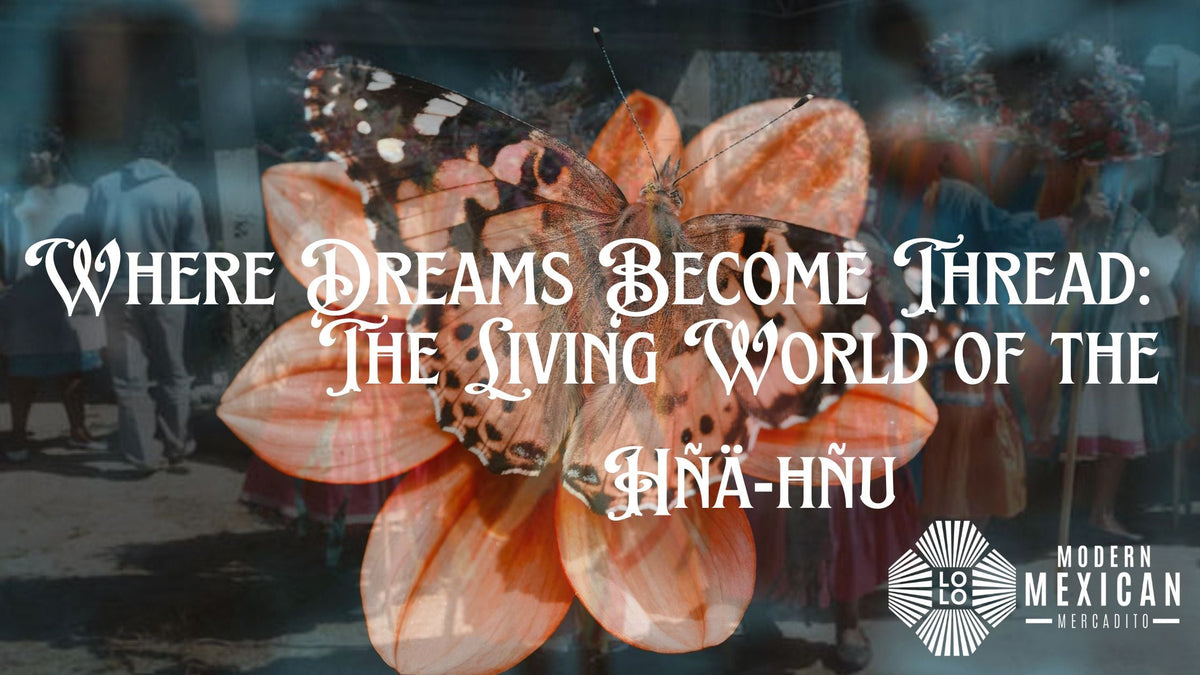
Stories and Myths are a significant form of history that births life. Whether they are oral stories, written in ink or stitched into existence. These stories thread, color, memories and dreams. Within the embroidered landscapes of the Otomi, who call themselves hñä-hñu, “those who speak Otomi”, we enter a world where imagination is not separate from reality, but a continuation of it.

In the valleys of Hidalgo and Puebla, the hñä-hñu have long understood dreams as a place of movement, a crossing between worlds. Dreams are not fleeting illusions; they are spaces of encounter. Ancestors arrive, energies speak, and messages unfold through symbols: caves, rivers, animals, stones. These are not metaphors. They are presences.
Within their cosmology, stones, wemas hold life. They are ancestors, keepers of memory, and beings that communicate through dreams. For some Otomi to dream of a cave is not simply to imagine, it is to be invited. To sit, to listen, to remember where they came from.
And so, what happens when these visions move from the body into cloth? They become Tenangos.

The embroidered works you see within the Colectivo Sueños are not decorative compositions. They are translations of dream language into thread. Each animal carries presence. Each pattern reflects movement. Each scene unfolds like a narrative remembered from another place, another time, another state of being. A living imagination tied to layers of ancestry.
There is no strict beginning or end in these compositions. Figures float, repeat, transform. A deer may carry the spirit of a mountain. A bird may echo a message from beyond. A flowering plant may hold memory of cycles and offerings. Filling a canvas with reminders of the reciprocity between humans and the more-than-human world.

For the hñä-hñu, dreams are not bound by time or space. They are a realm where transformation is possible where the body, the earth, and the spirit shift and speak freely. In this liminal space, what was solid becomes fluid. What was singular becomes many. A person may walk as themselves and simultaneously as an ancestor, as an animal, as the land itself. The boundaries that separate one being from another, one moment from the next, dissolve like mist.
This same fluidity exists in the embroidery. What you see is not fixed. It moves with you. It reveals itself slowly. A figure that appears to be dancing may also be growing. A pattern that seems to end may continue in your peripheral vision, in your memory, in the dreams you have after living with the piece. The compositions do not demand to be read all at once, they unfold across time, the way a relationship unfolds, the way understanding deepens through repeated encounter.
In the hñä-hñu worldview, time itself is not linear. Past, present, and future exist together in the dream realm. An ancestor's wisdom arrives not as history, but as presence. A message from the earth speaks in the language of now. When you sit with a Tenango textile, you are sitting in this same temporality, where what was stitched generations ago remains alive, continues to breathe, continues to teach. The needle work does not preserve a moment; it opens a doorway that remains perpetually open.
Space, too, is reimagined. A cave in the embroidery is not simply a location on a map, it is a threshold, a gathering place, a womb of memory. A river is not just water moving downhill; it is a path of communication, a vein through which the world speaks. Mountains, stones, and animals occupy the same cloth not as separate objects arranged in perspective, but as presences that coexist, that speak to one another, that move through and around each other in ways that defy the logic of fixed geography.

To live with one of these pieces is to invite this understanding into your home to allow your own sense of time and space to soften, to become more permeable, to remember that transformation is always possible.
To live with one of these pieces is to live with a story that continues to unfold.

It is to bring into your space a fragment of a worldview where everything breathes with presence, where stone and body are kin, where animal and ancestor speak in the same language, where dream and waking life are threads of a single cloth. It is to honor a form of knowledge that has been carried not through books alone, but through the patient hands of countless makers, through memory held in the body, through the quiet repetition of needle and thread across generations, a lineage of knowing that refuses to be forgotten.
At Lolo Mercadito, we carry Colectivo Sueños' work not as objects, but as living textiles, each one a continuation of the dreamworlds of the hñä-hñu, each one an invitation to listen more closely.
Because sometimes, what is stitched is not just what was seen. It is what was remembered.
By Diana Rodriguez