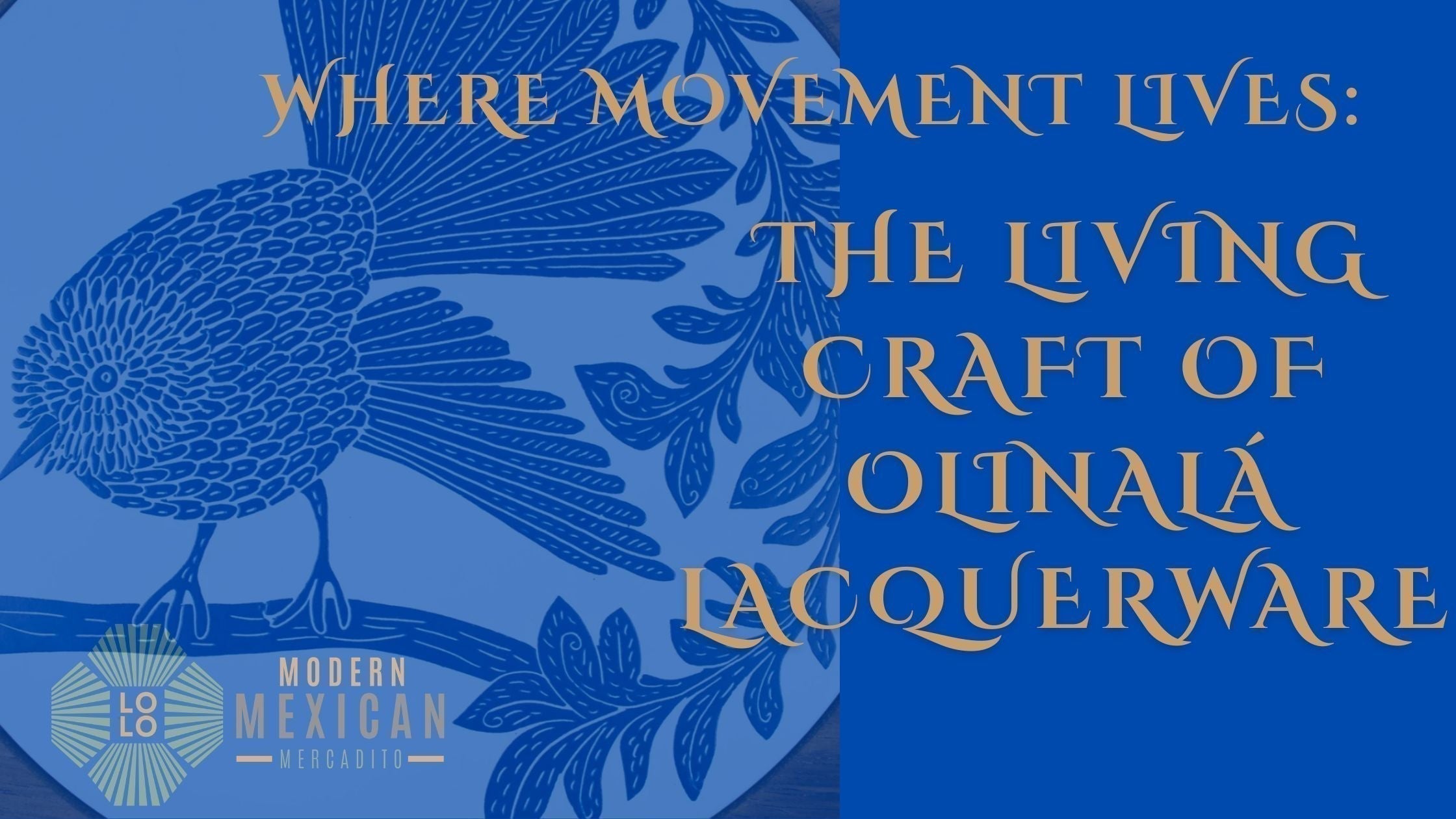
In the mountains of Guerrero, there is a place called Olinalá, known in Nahuatl as Ollinallan, "the place of movement." It is a name that feels true not only to the land itself, but to the way creation continues to live and shift through the hands of its artisans. Here, craftsmanship carries the stories of generations, shaped by memory and landscape.
Olinalá is more than a geographic location. It is a living archive of cultural knowledge, home to Nahua, Mixtec, Amuzgo, and Afro-descendant communities whose traditions have woven together over centuries. Situated in the Sierra Madre del Sur, the town's elevation and isolation have allowed distinct practices to flourish while remaining open to cultural exchange, a geography that mirrors its very name: "the place of movement."
The landscape directly shapes what emerges from Olinalá's workshops. Volcanic soils provide tecoztle, the mineral-rich rock that becomes pigment. Forests yield parota wood, prized for its grain and durability. Cool mountain air and seasonal rains influence how materials dry and how colors set. This convergence of geography and culture is visible in every piece—in the choice of wood, the mineral compounds used, and the patterns that reference both the natural world and ancestral memory. The mountains themselves become part of the work.

What distinguishes Olinalá lacquerware is not just the final image, but the philosophy embedded in its creation. An artisan might spend weeks on a single tray, moving through techniques that have been refined across generations. The dorado method builds luminous florals through layered color, reds blooming into golds, greens deepening into shadows. The rayado technique works through subtraction, carving fine lines into contrasting surfaces to reveal pattern underneath. The embutido method cuts designs into the wood and fills them with pigment, creating a tactile depth that invites touch.
Each technique requires different tools, different rhythms, different kinds of attention. A turkey feather quill becomes a brush for the finest details, its natural hollow shaft and tapered edge allowing artisans to achieve precision that rigid synthetic brushes cannot match. Historically, feather quills were among the earliest drawing and painting tools, used across cultures for centuries because their flexibility responds to the subtle pressure of a skilled hand. In Olinalá, the turkey feather's particular properties, its ability to hold pigment while maintaining a fine point, made it an ideal choice for the delicate work of layering color in the dorado technique, where florals emerge through careful, controlled strokes.
A deer-tail brush glides across surfaces with a softness that no synthetic tool can replicate. The deer tail's natural fibers are exceptionally fine and absorbent, qualities that made it valued in traditional painting and lacquerwork across Asia and Mexico long before modern alternatives existed. The brush's gentle action allows pigment to be distributed evenly without leaving harsh marks, essential when creating the smooth, luminous surfaces that characterize Olinalá's finest pieces. These tools emerged from necessity and observation, artisans discovering that natural materials responded to their hands in ways that honored both the technique and the material being worked.
These are not choices made for efficiency, they are choices made because they work, because they have always worked, because the hand knows them. The knowledge of which tool serves which purpose has been passed down through generations, refined through countless hours of practice. When an artisan reaches for a feather quill or deer-tail brush, they are drawing on centuries of accumulated understanding about how materials behave, how light catches pigment, and how the right tool becomes an extension of intention.
The process itself is a form of knowledge transfer. Young artisans learn not by instruction alone, but by standing beside experienced makers, watching how pressure is applied, how color is layered, how patience shapes the work. This is how tradition survives, not frozen in time, but alive in the body and hands of those who practice it.
Today, Olinalá continues to evolve. Artisans experiment with new color combinations while honoring traditional techniques. Collectives form to support one another and reach wider markets. The craft adapts without losing its essence, much like the name itself suggests, movement that carries memory forward.

What we see in Olinalá lacquerware is not simply decoration. It is a relationship to land, to material, to inherited knowledge. It is a way of remembering through making. Every piece carries within it the fingerprints of those who shaped it, the memory of forests where the wood grew, the volcanic earth that became pigment, the hands that refined these techniques across centuries. When you hold a lacquered tray or box from Olinalá, you are holding a conversation between past and present, between the artisan's vision and the material's own nature. This is why these objects endure, not because they are beautiful alone, but because they are alive with purpose and presence.

At Lolo, we honor this continuity by working with artisans and collectives from Mazic in Jalisco who carry these traditions forward. Through collaboration, materials from different regions, wood, clay, pigment, come together, echoing the same spirit that has always lived in Olinalá: a weaving of worlds, a movement between past and present.
When you choose a piece from our Olinalá collection, you are choosing more than an object. You are choosing to support artisans who dedicate their lives to this craft, who wake each morning to continue work that their grandmothers and great-grandmothers began. You are choosing to be part of a lineage that stretches back centuries and forward into a future these makers are actively creating.
Like all living traditions, Olinalá continues to evolve, carried through generations of hands that preserve its history while creating a future. The movement never stops. The craft never settles. And in that constant, careful evolution lies the true magic of these pieces.
By Diana Rodriguez