Many trees carry entire worlds within them. Rising from the earth; they hold stories in their bark, memory in their roots, and a presence that feels both protective and deeply alive.
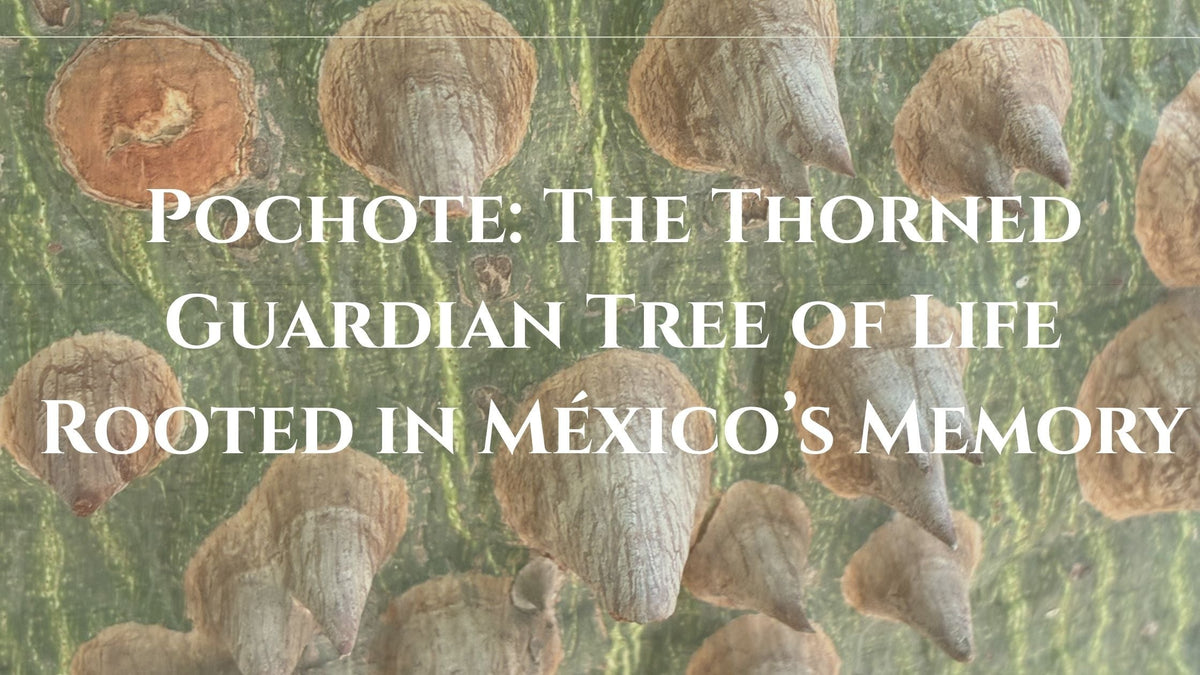
Pochote, from the Nahuatl word for cotton tree, rises from the dry forests stretching across México into Central America with a presence that feels both protective and ancient. Its trunk, armored in thick thorns, tells you everything before you even come close: this is a tree that knows how to endure. These thorns are not just defense, they are keepers of water, holding life through drought, storing what is needed when the land grows quiet and dry.
To stand before a pochote is to witness resilience made visible.


In many Mayan communities, this tree is known as Yaché, the sacred tree; it echoes the idea of the Yaxé, the Tree of Life. A living axis connecting the heavens above, the earth we walk on, and the underworld below. It is not a metaphor alone. It is a structure. It is a belief embodied in bark and root.
And so, the pochote becomes more than a tree. It becomes a bridge. A connection to various layers and existence of life.

Its presence across regions like Chiapas carries a quiet but powerful symbolism of resistance. The same thorns that protect it remind communities of strength, standing firm, and continuing despite harsh climates, both environmental and historical. It is said to bring good fortune to agricultural lands, calling in rains, holding space for growth, offering protection not just physically, but spiritually.

Its roots, in some traditions, are edible. Its bark and resin move between healing and ritual, used for inflammation, for insect wounds, for restoring the body in moments of imbalance. In different regions, its preparations shift, adapting to the knowledge of each community, but always remaining tied to care.
Its flowers open only at dusk, unfolding large, intricate blossoms that live briefly but fully. By morning, they fall, covering the ground they are like an offering back to the earth. Bats and insects arrive in the night, drawn to its blooms, continuing cycles of pollination that sustain entire ecosystems.
When the dry season comes, the pochote lets go. Its leaves fall early, conserving what it needs, waiting. And when the rains return, it responds all at once, lush, green, alive again.
Inside its fruit, a soft fiber, kapok, or pochote cotton, has long been used to fill pillows and cushions. Its seeds are toasted and eaten in places like Veracruz. Its wood becomes structure, homes, tools.

Across México, artisans translate the presence of trees like the pochote into objects that carry more than form. You begin to notice the textures, the raised patterns, the tactile surfaces that resemble thorned bark. You see it in clay, where the hand presses, repeats, remembers. You see it in vessels, in small cups, in planters that feel grounded, almost as if they, too, are rooted.
These are not decorative decisions. They are continuations.
When a piece holds the imprint of a tree like the pochote, it carries its story forward, the endurance, the protection, the quiet offering. It becomes something you live with, something you touch daily, something that slowly connects you back to land and lineage without needing explanation. A resilience that is textured, layered, and patient. That even in the harshest climates, there is a way to hold water, to wait, to return.
And in that way, the objects inspired by it become more than objects. They become reminders, appreciations to the trees who take care of our culture.

Make sure to check out our artisanal works such as Colectivo Lissandy with their inspiring Barro Negro Pochote Mug.
---
And so what did you think? How does the Pochote Tree speak to you? Have you ever encountered these thorned guardians in some place? Let us know in the comments.
We invite you to support our efforts to promote our cultura by sharing and exploring our mercadito, where you can shop authentic artisanal crafts carefully curated to represent true Mexican talent.
If you subscribe to our newsletter, you will get this and many more content of interest! We also make sure to give our familia of subscribers exclusive promotions, gifts, first-hand look at all new products and, of course, these articles that we love to write for you all!
By Diana Rodriguez