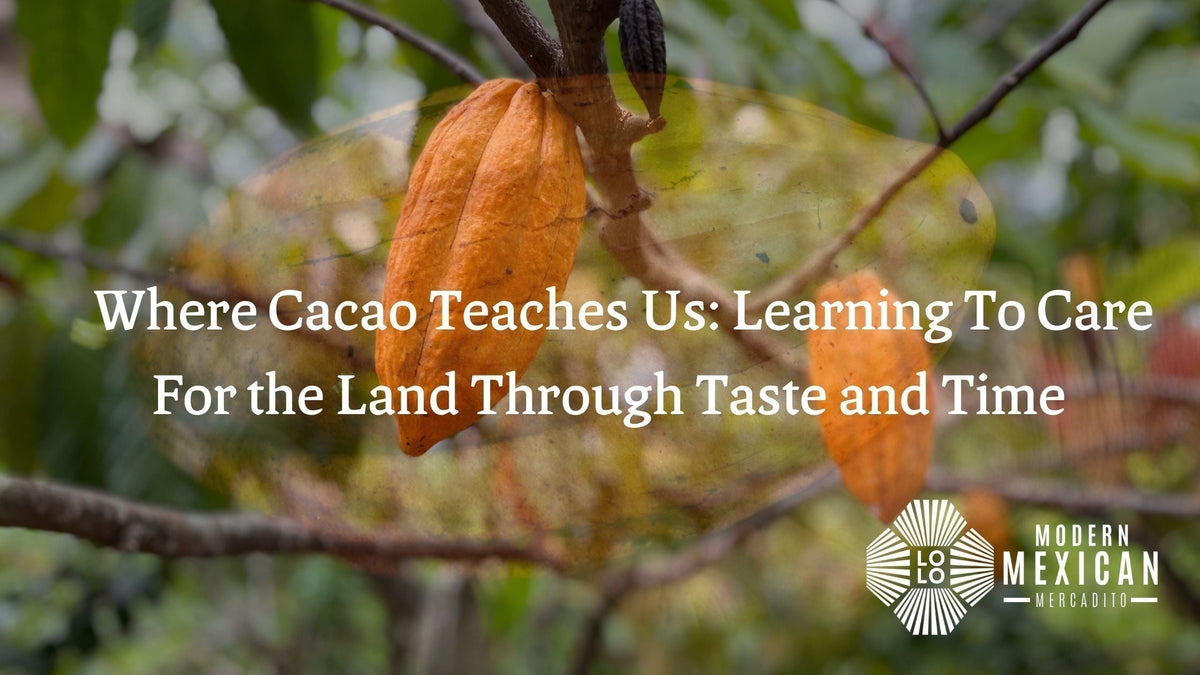
To begin speaking about cacao is also to begin learning how to love the land and how to care for it. Not as something separate from us, but as something we are in a relationship with. Cacao asks for attention, patience, and respect. It teaches that tending the earth is not a task, but a way of being.
For thousands of years, cacao has grown across the Americas from the lush edges of the Amazon and Orinoco rivers to the warm, humid regions of southern México. In places like Chiapas, Tabasco, Oaxaca, and Veracruz, cacao continues to be cultivated with intention. Not only for harvest, but to keep memory, ancestry, and knowledge alive.
Chiapas, nestled in the southernmost reaches of México, holds some of the most storied cacao traditions in the world. The region's volcanic soil, combined with its tropical climate and consistent rainfall, creates conditions where cacao thrives with remarkable depth. Here, cacao is not simply grown it is woven into the fabric of daily life. Families who have tended these lands for generations understand the rhythms of the plant, the way humidity shifts with the seasons, and how to coax from each pod flavors that speak of place and time. Chiapas cacao often carries notes of earth and spice, a richness that reflects both the soil and the knowledge passed down through hands that have always known how to listen to the land.
Oaxaca, equally sacred in the cacao world, brings its own character to the conversation. The region's diverse microclimates from coastal plains to highland valleys mean that cacao grown here can express itself in many ways. Some Oaxacan cacao carries bright, fruity notes; other batches reveal deeper, more complex profiles with hints of wood and smoke. What unites them is a sense of intentionality. In Oaxaca, cacao is often grown alongside other plants, a practice rooted in indigenous knowledge systems that understand the forest not as separate plots, but as a living whole. This approach to cultivation shapes not only the flavor of the cacao, but the health of the ecosystem that sustains it. Oaxacan chocolate makers have long been custodians of this tradition, transforming beans with methods that honor both the plant and the people who grew it.
Both regions represent something essential: cacao as a bridge between past and present, between the earth and those who tend it. When you taste chocolate made from Chiapas or Oaxaca cacao, you are tasting the result of generations of care, of knowledge that cannot be rushed or replicated elsewhere. This is why these regions continue to hold such significance in the world of fine chocolate, not because of marketing or trend, but because the relationship between land and cultivator runs so deep.

Among the earliest to shape cacao into something ceremonial were the Olmecs, who understood the seed as far more than sustenance. The Olmec civilization, which flourished across Mesoamerica, recognized in cacao something sacred, a bridge between the physical and spiritual worlds. They transformed the seeds into a drink that would become central to their rituals and daily life.
The preparation itself was an act of intention. Cacao pods were harvested, fermented, and dried with care. The beans were then roasted and ground by hand using stone tools, a labor-intensive process that required skill and patience. This ground cacao was mixed with water and often infused with herbs, spices, and sometimes chile, creating a bitter, complex beverage that was quite different from the sweetened chocolate we know today. The drink was frothy, energizing, and deeply connected to ceremony.
For the Olmecs, cacao ceremonies were moments of profound significance. The drink was prepared and shared during important gatherings, rituals that honored the gods, marked transitions, and strengthened community bonds. It was offered in moments of celebration and in times of spiritual need. The act of preparing and sharing cacao became a language of respect, a way of acknowledging both the earth that produced it and the people gathered to receive it.
What made cacao so central to Olmec life was not only its rarity and the effort required to cultivate and prepare it, but also its effects. Cacao contains compounds that elevate mood and sharpen focus, qualities the Olmecs likely understood through direct experience. In their hands, cacao became medicine, offering, and communion all at once.
This ceremonial relationship with cacao would echo through the centuries, passed forward to the Maya and later to the Mexica peoples, each culture adding their own understanding and reverence to the seed. It carried both sustenance and meaning, a duality that remains at the heart of cacao's story today.

Over time, cacao also moved through communities as a form of exchange, holding value not only in taste, but in trust.
There are about twenty-two varieties of cacao, each shaped by the conditions that surround it. Criollo, often considered one of the most delicate, is known for its complexity, light bitterness, soft fruit notes, and a subtle nuttiness. It is rare, not by chance, but because it demands care. Sensitive to climate and environment, it yields less and requires patience, which makes every harvest feel like something precious.
Forastero, by contrast, is more resilient. It adapts to changing weather and produces more abundantly. Its flavors can shift depending on how it is fermented and prepared, sometimes rich and deep, sometimes bright and fruit-forward. Together, these varieties remind us that flavor is not fixed, it is shaped by the hands and the land that guides it.
The cacao tree itself asks for very specific conditions, warmth, humidity, and deep soil. Its roots reach far into the earth, drawing from what cannot always be seen. In many ways, it mirrors the communities that continue to care for it, those who understand that to cultivate cacao is also to cultivate a relationship with the land.
Across Mesoamerica, cacao has long carried symbolic meaning. It is often seen as a gesture of abundance. In Mexica traditions, it was offered to Quetzalcóatl, and prepared for leaders and warriors in moments of ceremony. Among the Maya, cacao lived within texts and memory, where a drink known as xocoatl was prepared as an offering. Connecting the elements of earth, fire, wind, and water into something shared and intentional.
And while cacao carries this deep cultural presence, it also continues to support the body in tangible ways, rich in antioxidants, minerals, and compounds that have been known to support heart health, mood, and clarity of mind.

At its core, cacao is a practice of care. It reminds us that learning to love the land is something that happens over time, through observation, through work, through respect. It is in this relationship that cacao continues to exist, not just as something we consume, but as something that teaches us how to live in balance.
We invite you to check out our chocolate like Metiche, Amarte, and Kutzi. As well as the handcrafted Molinillos to make any of chocolate beverages extra-special. Either for your own nourishment, or as a thoughtful gift to others.
Here at Lolo, we continue to seek out those who honor this relationship. Makers who work close to the source, who understand cacao not just as an ingredient, but as something alive. From small-batch chocolate rooted in Tabasco to cacao sourced in Chiapas and transformed with intention, each offering carries its own story.
By Diana Rodriguez